
Julian Taylor

Julian qualified as a solicitor in 1990. Before launching Julian Taylor HR Solicitors he set up and ran a highly successful employment department in a leading law firm with offices in London and the Thames Valley.

Proposed Changes to Collective Redundancy Rules

Collective redundancy obligations in the UK currently arise under the Trade Union and Labour Relations (Consolidation) Act 1992 (TULRCA) when an employer proposes 20 or more redundancies within a 90-day period at one establishment.

In practice, an “establishment” is usually interpreted as a specific site – such as a store, office, or warehouse. As a result, organisations operating across multiple locations may carry out large-scale redundancies across different sites without triggering collective consultation obligations, provided that fewer than 20 redundancies occur at any single establishment.

A proposed shift in the law

Section 29 of the Employment Rights Act 2025 proposes amendments to TULRCA that would introduce an additional, alternative threshold based on the total number of redundancies across the entire business.

In other words, even if fewer than 20 redundancies are proposed at any single establishment, employers could still be required to undertake collective consultation if the total number of proposed redundancies across the organisation reaches a specified level.

Government consultation now open

The UK government recently launched a consultation to determine what this new threshold should be.

Its preferred approach is a single fixed threshold, likely to fall somewhere between 250 and 1,000 redundancies across the business as a whole.

However, the consultation also explores a tiered model, where the trigger would vary depending on organisational size:

  • 250 redundancies for organisations with 0–2,499 employees
  • 500 redundancies for organisations with 2,500–9,999 employees
  • 750 redundancies for organisations with 10,000+ employees

What this means for you

If implemented, these changes could significantly expand the circumstances in which collective consultation is required, particularly for large organisations with complex or multi-site workforces:

  • Redundancy planning may need to be assessed across the whole organisation, not just site-by-site.
  • Workforce reduction strategies that previously fell outside collective consultation rules may soon fall within scope.
  • Early workforce planning and legal input will become even more important.

The consultation is open until 21 May 2026.

Proposed Changes to Collective Redundancy Rules Read More »
Fire and rehire is about to change – from January 2027

Under the Employment Rights Act 2025, from January 2027 (under the revised timeline);

Dismissal to force certain contract changes will be automatically unfair

If you dismiss someone for refusing to agree a “restricted variation”, it will be automatically unfair unless you can prove:

  • Serious financial difficulties threatening business viability (i.e. imminent risk of insolvency)
  • The changes are necessary to address those difficulties
  • There is no realistic alternative

“Restricted variations” are likely to include the following (although specifically which is currently subject to government consultation):

  • Reductions in Pay
  • Pensions
  • Working hours
  • Shift patterns (in specified cases)
  • Time off
  • Or inserting clauses allowing such changes without consent

This sets a high bar. In most cases, dismissal and re-engagement to worsen core terms will no longer be lawful.

The rights are day one rights. There is no need for a period of qualifying service.

Other contractual changes

Changes outside the restricted list (e.g. mobility clauses, job duties, notice periods, restrictive covenants) aren’t automatically unfair — but tribunals must now assess:

  • The business reason
  • The quality of consultation
  • What was offered in return
  • Any other prescribed factors

Process and evidence will be critical.

Replacing employees with non-employees

Dismissing staff to replace them with agency workers or contractors doing substantially the same work will also be automatically unfair (unless the same serious financial difficulties defence applies).

Increased Penalties

The Maximum penalty for failing to consult on collective redundancies (which is often the appropriate process in fire and rehire) will be increased from 90 to 180 days pay.

What this means for you;

Now is the time to:

  • Audit upcoming contract change needs
  • Strengthen consultation frameworks
  • Educate senior leaders
  • Document business rationale rigorously
  • Build negotiation capability

Contract variation strategy now needs to be collaborative, evidence-led, and carefully managed.

Fire and rehire is about to change – from January 2027 Read More »

Major changes to unfair dismissal are coming January 2027

What you need to know

The Employment Rights Act 2025 introduces two significant reforms that will reshape dismissal risk and strategy from 1 January 2027.

  1. The Qualifying Period Is Reducing – Not Disappearing

While the original proposal under the Employment Rights Bill was to make unfair dismissal a day-one right, that has been amended.

From January 2027, the qualifying period will reduce from two years to six months.

It’s not limited to new hires so any employee with six months’ service at the implementation date will qualify.

  1. The Compensation Cap Is Being Removed

Currently, compensation awards for ordinary unfair dismissal are capped at the lower of one year’s salary or the statutory maximum (currently £118,223).

From 1 January 2027, that cap will be removed.

Tribunals will still assess what is “just and equitable,” but the financial ceiling disappears – particularly relevant for senior and high-earning employees.

What you need to do now

These changes require proactive planning.

Review probation frameworks; ensure clear review milestones and manager prompts before month 4 and 5 – avoid accidental qualification due to delayed reviews or postponed meetings

Rethink senior executive exits; We may see a move toward more structured performance management at senior levels – clearer expectations, documented evidence, and genuine opportunities to improve.

Prioritise respect in exits; High-value claims are often driven by perceived unfairness, not just dismissal. A well-managed process can significantly reduce litigation risk.Respect, transparency, and proportionate ex gratia payments remain powerful risk mitigators.

Prepare for higher-value claims; Once the cap goes, high earners have greater incentive to litigate. Settlement Agreement negotiations will become more complex and long-term loss of earnings arguments (especially involving older workers or health conditions) carry greater financial risk

2026 should be the year HR teams review probation systems, performance management capability, and executive exit strategy before the new regime takes effect.

If you haven’t started yet, now is the time.

Major changes to unfair dismissal are coming January 2027 Read More »

New changes to Paternity Leave rules in 2024

The Government has now published the Paternity Leave (Amendment) Regulations 2024. The Regulations apply in all cases where the estimated week of childbirth (EWC) is on or after 6 April 2024

Key changes of the Paternity Leave rule changes

  • Employees will be able to take their two-week paternity leave entitlement as two separate blocks of one week
  • Employees will be able to take paternity leave at any time in the 52 weeks after birth
  • Employees will only need to give 28 days’ notice of their intention to take paternity leave

Suggested action for Employers:

  • Relevant policies will need amending to reflect these changes and managers should be made aware so that absences on paternity leave can be planned and effectively managed.

If you’re a business that needs support navigating the new Paternity Leave rules don’t hesitate to reach out.

New changes to Paternity Leave rules in 2024 Read More »

New changes to Flexible Working in 2024

With effect from 6 April 2024 all employees, regardless of their length of service, will have the right to request flexible working.

Key changes to Flexible Working

  • A Day 1 right for all employees (for applications made on or after 6 April 2024)

The Government published wider changes to flexible working last autumn. Government guidance states it is ‘expected’ that these additional changes will come into effect at the same time that flexible working becomes a Day 1 right (i.e. for applications on or after 6 April 2024).  

The wider changes are as follows:

  • Removing the requirement for employees, in their written request, to set out what effect the proposed flexibility would have on the employer’s business and how any effect could be dealt with.
  • Increasing the number of flexible working requests which can be made in any 12- month period from one to two.
  • Requests must be consulted on and decisions made within 2 months. As before, it will remain possible, by agreement with the employee, to extend this time period.

Suggested action for Employers

  • Have two revised flexible working policies ready to go on 6 April: one which merely removes the requirement for 26 weeks’ service, the other which removes this provision but also incorporates the other changes listed above.

If you’re a business that needs support navigating the new changes to Flexible Working in 2024 don’t hesitate to reach out.

New changes to Flexible Working in 2024 Read More »

New changes to Redundancy Protection in 2024

From 6 April extra protection in the context of redundancy to those on Maternity, Paternity or Shared Adoption leave is being extended. They have the right of first refusal for any suitable alternative roles in a redundancy situation.

Key facts around Redundancy Protection

  • Pregnancy: 
    Currently: No protection. 
    Changes: Protected from the date the employee informs the employer of her pregnancy for the full period of pregnancy. Effective where the employer is informed of the pregnancy on or after 6 April 2024.
  • Maternity Leave: 
    Currently: Protected during the period of absence on maternity leave only. 
    Changes: Protected for 18 months from the first day of the estimated week of childbirth (EWC). The 18-month period can be altered to start from the child’s actual date of birth where the employee informs the employer in writing of the actual date during their maternity leave period. Effective where the maternity leave ends on or after 6 April 2024.
  • Adoption Leave: 
    Currently: Protected during the period of absence on adoption leave only. 
    Changes: Protected for the period of 18 months from the date of placement for adoption. Effective where the adoption leave ends on or after 6 April 2024.
  • Shared parental leave: 
    Currently: Protected during the period of absence on shared parental leave only. 
    Changes: Protected for 18 months from birth/placement for adoption provided that the employee has taken a period of at least six continuous weeks of shared parental leave. This protection will not apply if the employee otherwise has protection under either the maternity or adoption provisions above. Protected during period of absence on shared parental leave only (as now) if fewer than 6 consecutive weeks of leave are taken. Effective from where the period of six continuous weeks of shared parental leave starts on or after 6 April 2024.
  • Miscarriage: 
    Currently: No protection if the employee suffers a miscarriage any time before the end of 24 weeks of pregnancy. If they miscarry after 24 weeks they are entitled to current maternity leave protection. 
    Changes: Where an employee suffers a miscarriage before the end of 24 weeks of pregnancy, they will have protection during their pregnancy and for a two-week period following miscarriage. If they miscarry after 24 weeks of pregnancy this is classed as a still birth, they are entitled to maternity leave and will have the same protection as any other employee taking maternity leave.

Suggested action for Employers

  • If you have a redundancy policy and it already refers to redundancy protection, update it to reflect the extension of protection.
  • Make sure employees who have taken leave do not get forgotten in a redundancy scenario (which is possible given the lengthy period 18-month period of protection). Consider placing flags on employee records against those who have taken leave setting out their period of extended protection.
  • Inform managers of the extension of this special status so that it can be factored into redundancy proposals at a formative stage

If you’re a business that needs support navigating the new Redundancy Protection changes don’t hesitate to reach out.

New changes to Redundancy Protection in 2024 Read More »

New changes to Annual Leave & Holiday Pay in 2024

The Government has created an entirely new system of holiday accrual and holiday pay for part-year and irregular hour workers as defined in the new regulations.

Key Features for the Annual Leave & Holiday Pay regulations

  • The new rights will be set out in Regulation 15B to 15F of the Working Time Regulations 1998.
  • Taking effect for holiday years commencing on or after 1 April 2024 so for employers with a holiday year running from January this will not take practical effect until 2025.
  • A new holiday accrual method under regulation 15B, https://www.legislation.gov.uk/uksi/1998/1833/regulation/15B  whereby holiday accrues based on 12.07% of the hours worked by the worker in the previous pay period.
  • An option under regulation 16A https://www.legislation.gov.uk/uksi/1998/1833/regulation/16A for employers to use ‘rolled up’ holiday pay (provided that certain conditions are met). This is where holiday pay for regulation 15B holiday can be paid as an additional percentage of pay at the time when the hours worked are paid for, rather than being paid when the annual leave is taken.

Suggested Actions for Employers

  • Work out if you currently engage any part-year or irregular hours workers
  • Decide whether you wish to pay rolled-up holiday pay to any such individuals
  • Undertake all necessary discussions with payroll functions to make sure that your workplace arrangements are ready to administer this new system of accrual and pay
  • Review any holiday policy in place and make all necessary changes to take account of the new arrangements
  • Consider whether you need to issue revised terms and conditions of employment to reflect these changes.

New changes to Annual Leave & Holiday Pay in 2024 Read More »

New changes to the Carer’s Leave Regulations 2024

The Carer’s Leave Regulations 2024 come into force on 6 April 2024. 

Key Features of Carer’s Leave

  • The right is a Day 1 employment right.
  • The right applies to employees who have a dependant with a long-term care need and want to be absent from work to provide or arrange care for that dependant.
  • Requests can be in consecutive or non-consecutive half-days or full days
  • Employees must give notice in writing of their intention to take carer’s leave.
  • Employers can postpone a request if the operation of the business would be unduly disrupted.
  • Employees are protected from detriment and dismissal because they take or seek to take carer’s leave or the employer believes they are likely to do so.

Suggested Action for Employers:

  • Consider creating a new policy or add a reference to carer’s leave in any existing policy dealing with other family/dependant leave.

You can read the new regulations on Carer’s Leave here.

If you’re a business that needs support navigating the new Carer’s Leave Regulations don’t hesitate to reach out.

New changes to the Carer’s Leave Regulations 2024 Read More »

Call to make the Statutory Sick Pay Rebate Scheme permanent 

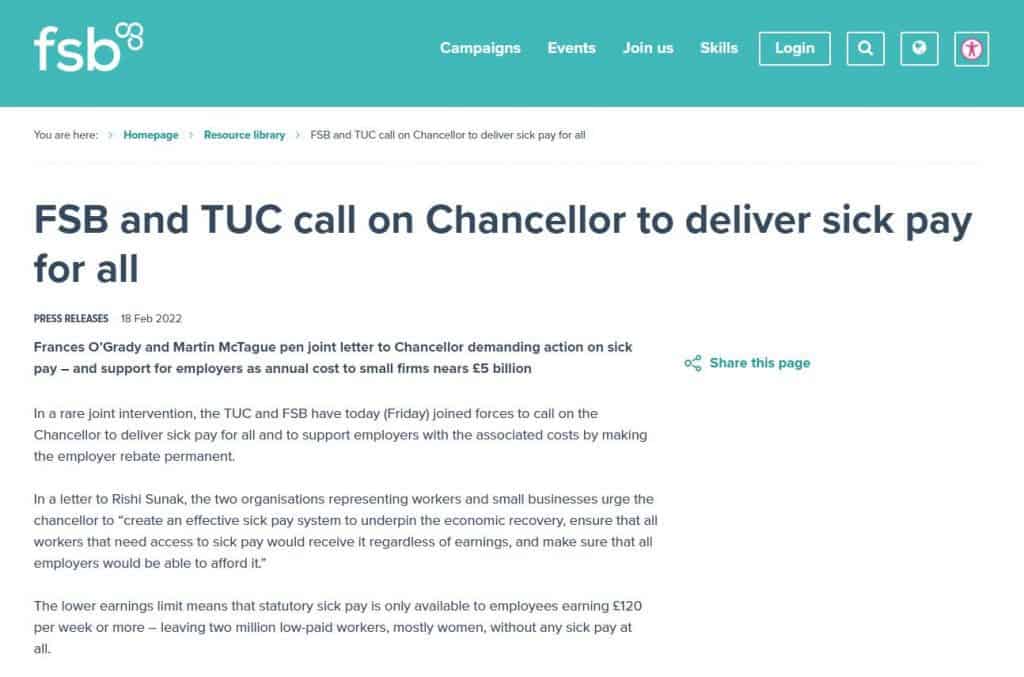
The Federation of Small Businesses (FSB) and the TUC have jointly called on the government to make the Statutory Sick Pay Rebate Scheme permanent.

FSB sick pay statement
FSB and TUC joint statement on the sick pay rebate scheme request [source]

With the aim of making sick pay more widely available and supporting small employers (with fewer than 250 employees) with the costs of this they have asked that the rebate scheme be made permanent. 

They have also asked that it be extended to cover all sickness not solely Covid related.

The present rebate scheme was re-introduced for small employers to assist with the costs of Covid related absences in January 2022 for a limited duration until 24 March 2022.

Call to make the Statutory Sick Pay Rebate Scheme permanent  Read More »

Scroll to Top